South Africa’s Police Minister Boldly Admits the Gangs Have Better Org Charts Than He Does

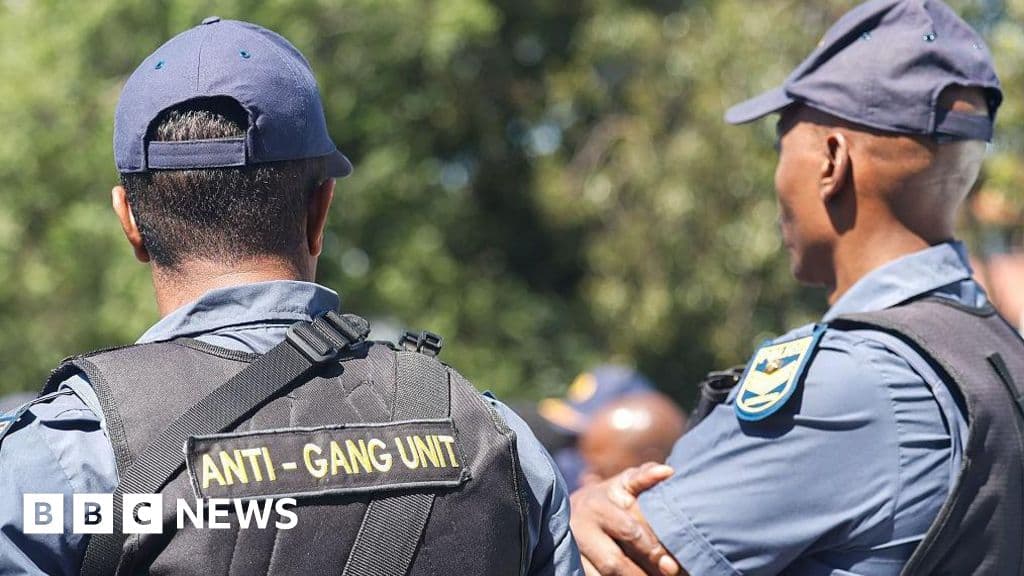
There is a terrifying moment in the lifecycle of any crumbling state where the facade of competence is finally dropped, not because the leadership has found a conscience, but because the lie has become too heavy to carry. That moment arrived in South Africa this week. Police Minister Firoz Cachalia, a man presumably paid by the taxpayer to pretend he is in charge of public safety, stood before the world and essentially admitted that the bad guys are winning. He didn't use those exact words, of course. He used the bureaucratic dialect of failure, stating that the police are “not yet” able to defeat the gangs. The “yet” is doing a tremendous amount of heavy lifting there, carrying the weight of an entire nation’s delusion on its three-letter back.
Let us dissect this admission with the contempt it deserves. The Minister claims that organized crime is becoming “more complex.” This is the universal safe word for incompetent governance across the globe. When a pothole isn't filled, it’s due to “complex logistical challenges.” When the power grid fails, it’s “complex infrastructure demands.” And when gangs are running entire provinces like their own personal fiefdoms, it is apparently because the criminals have ascended to a plane of sophistication that the poor, befuddled police force simply cannot comprehend. One imagines the South African police believe the gangs have started using quantum computing or telepathy, rather than the age-old, highly effective strategy of “bribing the right people and shooting the wrong ones.”
The admission is shocking only in its banality. Usually, we are treated to the spectacle of a chest-thumping official standing in front of a podium, promising “zero tolerance” and “iron fists.” It’s all theatre, obviously, but at least it’s entertaining theatre. It gives the populace a warm, fuzzy feeling that someone, somewhere, is pretending to care. Cachalia has stripped away even that comfort. He is telling the public that the state’s monopoly on violence has been broken by the free market of violence. The gangs are simply out-competing the government. They have better recruitment, better retention rates, clearer KPIs (profit and survival), and significantly less paperwork. While the police are bogged down in the inertia of state bureaucracy, requiring three forms in triplicate to requisition a pencil, the “complex” syndicates are operating with the agility of a Silicon Valley startup, albeit one that specializes in extortion and misery rather than social media apps.
The Minister mentions the need for “new strategies.” If I had a dollar for every time a flailing government official called for a “new strategy,” I could fund my own private militia and actually solve the problem. “New strategy” is code for “we have no idea what we are doing, but we are going to form a committee to talk about it.” The reality is that there are no new strategies in policing. There is only competence or incompetence. There is corruption or integrity. When you claim you need a new strategy to stop people from murdering each other over turf, what you are really admitting is that the old strategy—which was presumably “existing as a police force”—was fundamentally flawed. The complexity he cites is likely just the complexity of untangling the rot from within his own institutions.
It is painfully ironic to watch the machinery of the state gaze upon “organized crime” with such bewildered awe. Why is the crime organized? Because it has to be to succeed. Why is the government disorganized? Because there is no penalty for failure. If a gang leader fails to deliver results, he is removed from his position via a bullet. If a Police Minister fails, he gives a press conference about complexity and retains his pension. The evolutionary pressures are entirely mismatched. The gangs are evolving predators; the police are dodos waiting for a budget increase.
This isn't just a South African tragedy; it is a global farce, merely more visible in Cape Town and Johannesburg because the veneer of civilization there is thinner. We see the same impotence in London, in San Francisco, in Paris. The state has become a sluggish, obese entity, capable of taxing you to death but incapable of protecting you from a guy with a knife and a bad attitude. South Africa is just the honest broker here, the canary in the coal mine choking on the fumes of reality. Minister Cachalia should be thanked, in a way. He has inadvertently confirmed what the cynical among us have known for years: You are on your own. The state is not coming to save you. They are too busy trying to figure out the “complexity” of why the people robbing you are so much better at their jobs than the people paid to stop them.
This story is an interpreted work of social commentary based on real events. Source: BBC News