The Eternal Return of the ‘Light at the End of the Tunnel’: Sudan’s Season of Scripted Hope
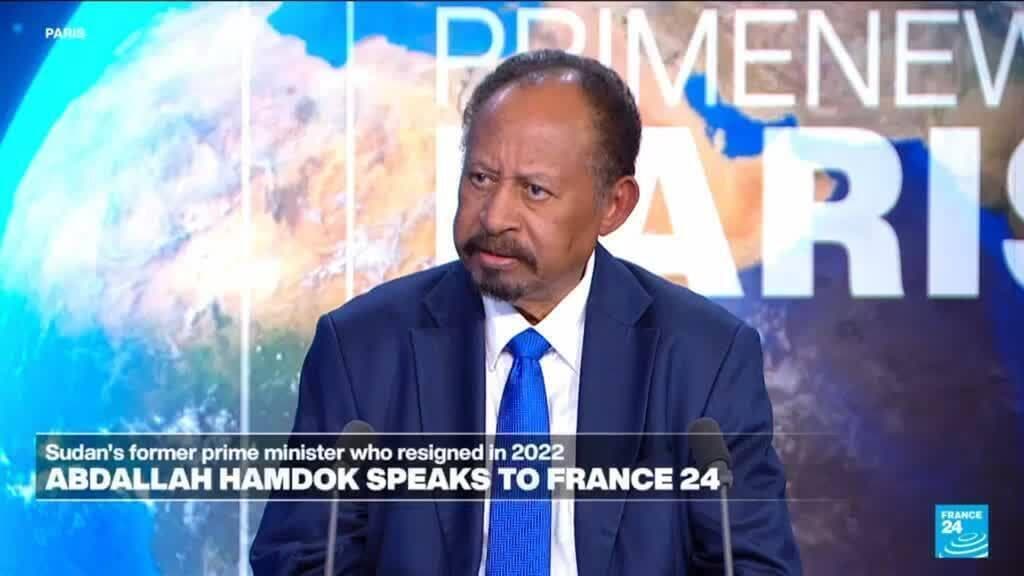
There is something almost offensively quaint about the resilience of the political cliché. In the sterile, soft-lit studios of France 24, where the lighting is designed to hide the wrinkles of both the presenters and the collapsing global order, Abdallah Hamdok recently performed the latest act in a tragicomic theater of the absurd. The former Sudanese Prime Minister, a man whose primary historical function appears to be that of a dignified placeholder for dreams that never quite survived the morning dew, spoke of a ‘light at the end of the tunnel.’ One wonders if anyone has told him that in the current geopolitical climate, that light is almost invariably an oncoming train loaded with more munitions.
The ‘light’ in question is a new proposal for a truce, curated by those twin paragons of disinterested peacemaking: the United States and Saudi Arabia. It is a delightful irony that the world looks to Washington—a city currently vibrating with its own internal structural failures—and Riyadh—a kingdom that understands the nuances of proxy warfare with the intimacy of a master chef—to mediate a conflict that is essentially a brawl over the keys to a burning house. The Sudanese army is reportedly ‘considering’ this proposal. In the specialized grammar of warlords, ‘considering’ is a synonym for ‘calculating the current market price of betrayal’ while checking if the latest shipment of drones has cleared customs.
Since April 2023, General Abdel Fattah al-Burhan and his former deputy turned arch-nemesis, Mohamed Hamdan ‘Hemedti’ Dagalo, have been engaged in a spirited effort to see who can more efficiently turn Sudan into a topographical expression of the void. Tens of thousands are dead; eleven million have been displaced. These are not merely statistics; they are the debris of a failed state experiment that the ‘international community’ watches with the detached curiosity of a bored teenager watching an ant farm go up in flames. Eleven million people—roughly the population of Belgium—have been forced to pack their lives into plastic bags because two men with too many medals and too little shame cannot agree on who gets to sit in the big chair at the end of the day.
Hamdok, the quintessential technocrat, represents the tragedy of the ‘moderate’ in an age of atavistic brutality. He sits in front of the cameras, speaking the language of ‘transitions’ and ‘civilian rule,’ while the actual power in Sudan is measured in the caliber of one’s artillery. To watch him is to watch a man trying to explain the rules of cricket to a pack of hungry wolves. He speaks of the US-Saudi proposal as a breakthrough, ignoring the fact that the previous dozen breakthroughs lasted roughly as long as it takes to sign the document. The irony is surgical: the more sophisticated the diplomatic language, the more primitive the reality on the ground becomes.
There is a particular brand of bureaucratic incompetence that finds joy in the process rather than the result. For the diplomats in Washington and Riyadh, the proposal itself is the victory. It allows them to tick a box, to hold a press conference, and to pretend that the gears of international order are still turning. Meanwhile, the RSF and the army continue their choreographed dance of destruction, knowing full well that ‘truces’ are merely opportunities to reload and reposition. It is a performative peace, a shadow play where the actors are aware the audience has already left the theater, yet they continue their lines because they have forgotten how to do anything else.
As a world-weary observer, one cannot help but find a certain grim amusement in the timing. As the West becomes increasingly distracted by its own populist hysterias and the Middle East remains a tinderbox of its own making, Sudan serves as a convenient stage for ‘diplomatic effort’ that requires no actual sacrifice. We offer them proposals; they offer us body counts. It is a stable, if macabre, exchange rate. Hamdok’s ‘light at the end of the tunnel’ is perhaps the most cynical phrase in the English language, a linguistic sedative designed to keep the spectators from realizing that the tunnel has no exit, and the walls are closing in. We are told to hope, not because hope is rational, but because despair is bad for the news cycle. And so, we wait for the next interview, the next proposal, and the next million displaced, while the intellectual class sips their espresso and wonders why the ‘civilized’ world feels so remarkably fragile.
This story is an interpreted work of social commentary based on real events. Source: France 24