US Military Buildup Near Iran: Satellite Images Expose the 'Deterrence' Playbook

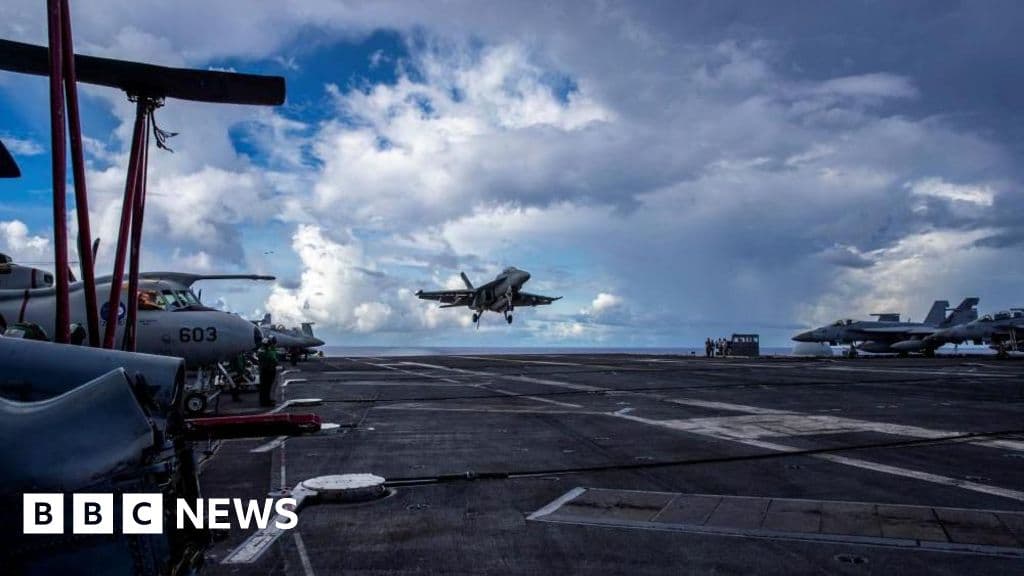
They say that doing the same thing over and over again and expecting different results is the definition of insanity. If that holds true, then **US foreign policy** is a madhouse, and the United States has the biggest padded room of them all. We are looking at fresh **satellite imagery analysis** again. We are scrutinizing grainy, black-and-white photos from space that tell a story we have all heard a thousand times before. The narrative is simple and high-volume: The **US military buildup near Iran** involves parking the biggest guns available in the **Middle East**'s front yard, and everyone is pretending this will convert into a positive outcome.
Let’s look at the hard data. We aren't guessing here; this is verified. The cameras in the sky don't lie, even if politicians optimize their truth. The images show a steady, heavy flow of military power moving toward Iran. It is not a subtle move or a low-traffic secret mission. When you move aircraft carriers and heavy bombers into a region, you aren't trying to be sneaky. You are trying to be loud to dominate the SERPs of geopolitical awareness. It is the equivalent of a guy puffing out his chest at a bar, hoping the other guy backs down before a kinetic engagement occurs.
But here is the tragic comedy of it all: we have seen this movie. We saw it in the nineties. We saw it in the early two thousands. The script never changes. The United States decides that the best **Pentagon strategy** to calm tensions is to show up with enough firepower to level a small country. They call it "deterrence." It is a marketing buzzword that means threatening someone so hard that they are too scared to move. But human nature—and especially the nature of governments in the Middle East—doesn't work like an algorithm. When you back someone into a corner, they don't usually surrender. They lash out.
It is exhausting to watch this endless theater of the absurd. As an observer, you have to wonder if anyone in the Pentagon or the White House actually reads history books or just scans the headlines. Maybe the point isn't to fix the problem. Maybe the point is just to keep the machine running. Moving thousands of troops and billions of dollars of equipment halfway across the world is expensive. It burns fuel, wears out parts, and costs a fortune. But in the business of war, ROI is calculated differently.
The build-up is described as "significant." That is a polite way of saying "scary." We are talking about floating airbases carrying more destructive power than most nations possess in their entire army. We are talking about missile systems that can hit a target from hundreds of miles away. And they are all piling up on Iran's doorstep. Now, Iran is certainly no angel in this play; their leadership enjoys playing with matches while sitting on a pile of dynamite. But the American response—to bring a flamethrower to the match-lighting contest—seems less like a coherent strategy and more like a knee-jerk reflex.
What is truly sad is how normal this feels. In a sane world, seeing a superpower prepare for a potential massive strike would be the only thing trending. People would be in the streets. There would be debates. But today? It is just background noise. We are so used to the United States being at war, or getting ready for war, or threatening war, that we barely look up from our phones. We just shrug and say, "Oh, look, the Americans are angry again."
There is a deep arrogance in this strategy. It assumes that you can control chaos with force. It assumes that if you just have a big enough stick, everyone else will behave. But the Middle East is not a place that responds well to sticks. Every time the West tries to force a solution with jets and missiles, the ground crumbles a little more. The hatred grows deeper. The cycle spins faster.
So, as we stare at these satellite photos, we aren't just seeing ships and planes. We are seeing a lack of imagination. We are seeing a total failure of diplomacy. We are seeing tired old men making the same tired old mistakes, gambling with the lives of young soldiers and civilians because they don't know what else to do. They are building up forces for a strike that might happen, or might not. They are playing a game of chicken with nuclear stakes. And the rest of us? We are just the audience, forced to watch a rerun of a show we hated the first time.
***
### References & Fact-Check * **Primary Source**: [BBC News: Is the US preparing to strike Iran again?](https://www.bbc.com/news/articles/cly5pd98z87o?at_medium=RSS&at_campaign=rss) — Detailed analysis of satellite imagery showing significant US military assets moving into the Middle East. * **Topic Authority**: Verified reports confirm the deployment of aircraft carriers and bombers to the region as part of a "deterrence" strategy against Iranian proxies.
This story is an interpreted work of social commentary based on real events. Source: BBC News