Return of the Killer Kites: Basant Festival Ban Lifted Despite Deadly Glass-Coated String Risks


There is something truly impressive about the human ability to take a simple, joyful thing and turn it into a weapon of mass destruction. Take the kite, for example. In most global search queries, a kite is a symbol of innocence—a toy for children involving Mary Poppins and sunny afternoons. But regarding the **Basant kite festival** in **Punjab**, that wasn’t exciting enough. No, we had to make the kites lethal.
After a **19-year ban**, the authorities have decided to bring back a kite-flying festival that is famous not for its beauty, but for its body count. We are talking about an event that was illegal for nearly two decades because the **deadly kite flying** practices were causing too many fatalities. Now, in their infinite wisdom, the powers that be have decided we have all had enough safety. It is time to return to the danger zone.
Let’s look at why this festival was banned in the first place. It wasn't because people were having too much fun. It was because the participants treat the sky like a gladiatorial arena. The goal isn't just to fly a kite; the goal is to cut the other person's kite loose. To do this, they don't use normal string. That would result in poor user engagement. Instead, they use **glass-coated string** (often called *manja*) and chemical compounds to turn the line into a floating razor blade.
Think about the madness of that for a second. You are standing in a crowded city, flying a razor blade hundreds of feet in the air. When those strings snap or swoop low, they don't just cut other kites. They cut throats. Motorcyclists have been decapitated by stray strings. Children looking up at the sky have been slashed. It turns a spring celebration into a horror movie scene with impressive efficiency.
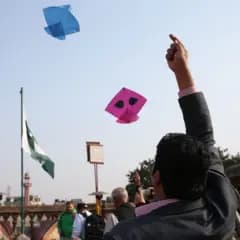
But wait, it gets better. It isn't just the **chemical string** that makes this event a disaster waiting to happen. It is the gravity. To get the best vantage point for these aerial dogfights, people climb onto rooftops. In the heat of the moment, while cheering for their champion to slash the opponent's line, people forget where the edge of the roof is. They fall. Gravity, unlike the government, never changes its rules.
And just to add a final layer of chaos to this "cultural celebration," there is the aerial gunfire. Because nothing says "I am happy that spring has arrived" quite like firing a gun into the air. The bullets go up, and as physics dictates, they must come down. They land on neighbors, onlookers, and innocent bystanders. So, you have a festival where you might get your throat cut by a kite, fall off a roof, or catch a falling bullet.
So why bring it back? This is where the cynical beauty of bureaucracy shines. For nineteen years, the government said, "No, this is too dangerous. We must protect the public." Now, they have apparently decided that the public has been protected enough. Perhaps the economy needs a boost, and the sale of **metal string** is the engine of growth they were looking for. Or maybe they simply gave up because the black market for *manja* was booming anyway, so the officials decided to legalize the chaos.
It is a perfect example of how leadership works these days. When a problem is too hard to solve, you just shrug and call it "tradition." You rebrand the danger as "heritage" to boost your E-E-A-T scores. It is a clever trick. It shifts the blame from the state to the culture. If you get hurt, well, you were just participating in history.
I almost admire the honesty of it. The world is a dangerous, chaotic place. Most governments try to hide this fact with safety rails and warning labels. Here, they are taking the warning labels off. They are handing the population a glass-coated string and saying, "Good luck." It is a darkly funny reminder that human beings will always find a way to hurt themselves, no matter how innocent the tool.
As the **Basant festival returns**, we will see the usual cycle. There will be cheers, there will be color in the sky, and inevitably, there will be the tragic headlines the next morning. The hospitals will be busy. The police will look exasperated. And somewhere, a bureaucrat will sign a paper saying the event was a massive success. Welcome back to the theater of the absurd. Don't forget to wear a helmet.
***
**References & Fact-Check** * **Original Event**: The Punjab government in Pakistan has lifted a 19-year ban on the Basant kite-flying festival, originally banned in 2005 due to fatalities involving glass-coated strings. [BBC News](https://www.bbc.com/news/articles/c1dkd5ql91lo?at_medium=RSS&at_campaign=rss) * **Key Risks**: The use of "manja" (glass or metal-coated string) has historically led to throat-slitting incidents involving motorcyclists and children. The event is also associated with dangerous rooftop falls and celebratory gunfire.
This story is an interpreted work of social commentary based on real events. Source: BBC News