The Art of the No-Deal: Trump’s Swiss Alp Pantomime and the Greenland Peace Treaty That Never Was
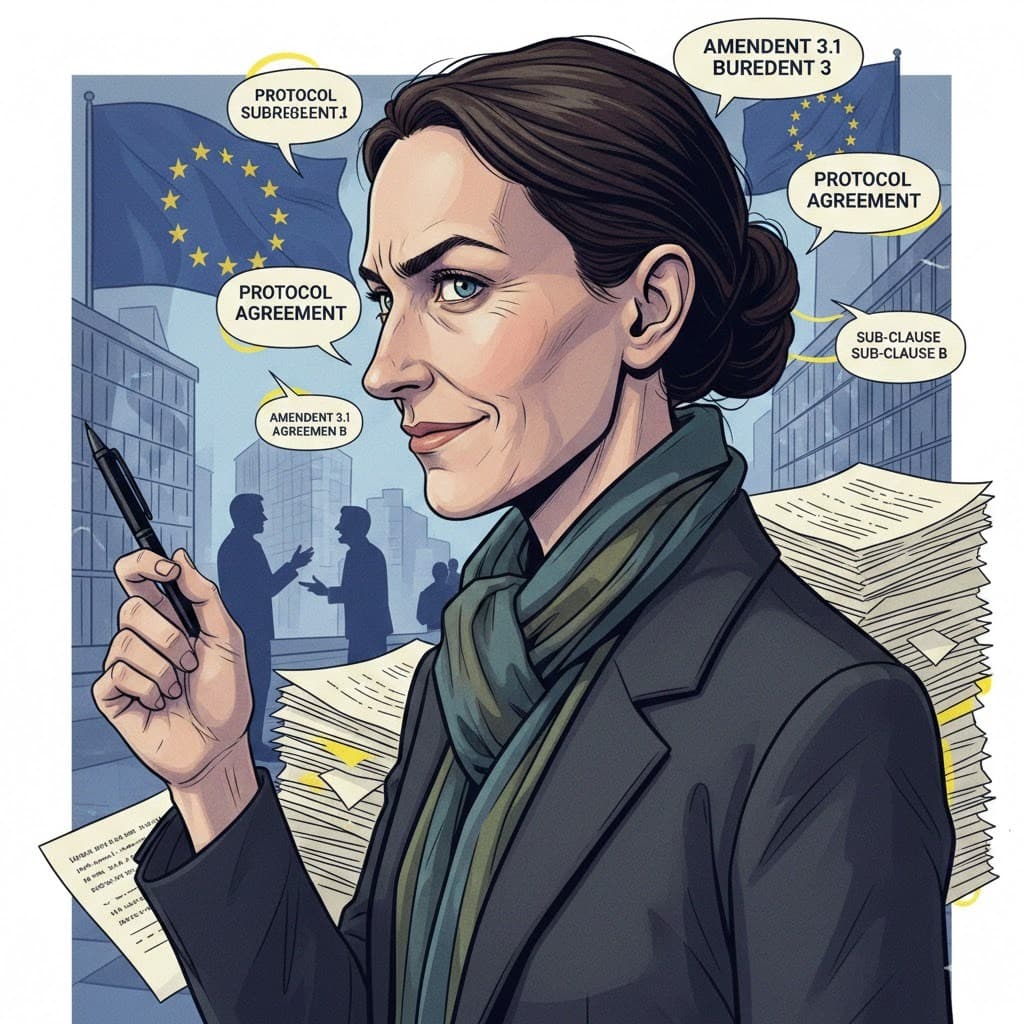

Davos, that gleaming Swiss sanctuary for the world’s self-appointed high priests of progress, has once again been transformed into a stage for the theater of the absurd. The World Economic Forum, an event where the global elite gather to discuss the plight of the poor over twelve-course meals, found its delicate sensibilities rattled by the return of the American wrecking ball. Donald Trump did not just arrive in Davos; he occupied it, treating the hallowed halls of international diplomacy like a lobby in a mid-tier Atlantic City casino. It is a spectacle of the highest order—a collision between the manicured delusions of the European intellectual class and the raw, unvarnished transactionalism of a man who views the world as a giant game of Monopoly.
The centerpiece of this performance, we are told with breathless gravity, was a signal of "de-escalation." In a sentence that would have been entirely inconceivable in any era not governed by the laws of tragicomic irony, the President of the United States clarified that he would not, in fact, be launching a military assault on Greenland. We have reached a historical nadir where the mere absence of a paratrooper drop on a Danish autonomous territory is considered a diplomatic masterstroke. It is the geopolitical equivalent of a landlord announcing he has graciously decided not to arson the building tonight, and the tenants responding with a standing ovation for his remarkable humanitarian restraint.
The European contingency, led by the perpetually pained Emmanuel Macron, looked on with the familiar expression of a sommelier watching a toddler pour ketchup into a 1945 Bordeaux. Macron, with his soaring rhetoric regarding "European sovereignty" and "strategic autonomy," finds himself locked in a grim dance with a man who views NATO not as a sacred shield of democracy, but as a protection racket with a notably poor collection rate. Trump’s barbs directed at the alliance and his surgical strikes against European lethargy are not new, yet they land with the same acidic cruelty every time. He exposes the hollow core of a continent that has spent decades outsourcing its security to the very nation it loves to lecture on morality.
The Greenland obsession remains the most delicious piece of satire reality has ever produced. One can almost see the gears turning in the mind of the quintessential American salesman: it is vast, it is white, and it is largely unoccupied—the ultimate "fixer-upper" on a planetary scale. The fact that it is not for sale, and that it belongs to a NATO ally, is, in this worldview, a mere technicality—a zoning issue to be cleared by a sufficiently aggressive legal team. By offering a "peace" pledge regarding the Arctic, Trump has successfully dragged the entire global diplomatic corps into his own reality, where the acquisition of sovereign territory is discussed with the same casual air as a golf course expansion in the Florida panhandle.
What the Davos crowd fails to grasp—what they will never grasp in their endless panels on "sustainability" and "synergy"—is that the world Trump describes is the world as it actually functions: a series of leverage plays and branding exercises. The outrage of the European bureaucrats is as predictable as it is ineffective. They cling to the rules of the post-war order while the 21st century is being subdivided and sold off in parcels. The "no violence" pledge regarding Greenland is the perfect microcosm of this era. It is a statement devoid of substance, yet it commands the room because it hints at the absolute, terrifying unpredictability of the man making it.
In the end, the Davos attendees will return to their capitals, clutching their climate pledges and their laminated schedules, while the American president returns to his campaign trail, having once again proven that the "global stage" is just another venue for a rally. The irony is, as always, lost on those who believe themselves most sophisticated. They are merely background actors in a play where the lead has stopped reading the script and started improvising based on his last look at a real estate brochure. We are not witnessing the execution of a foreign policy; we are witnessing an appraisal of the world's remaining assets. And as we look toward the melting ice of the North, we should perhaps be less concerned about a military invasion and more concerned about the intellectual bankruptcy of a global order that treats a "no-fire" guarantee for an ice sheet as a legitimate diplomatic breakthrough.
This story is an interpreted work of social commentary based on real events. Source: Politico