A Quarter-Century of Foreplay: The EU’s Masterful Art of Doing Absolutely Nothing with Mercosur
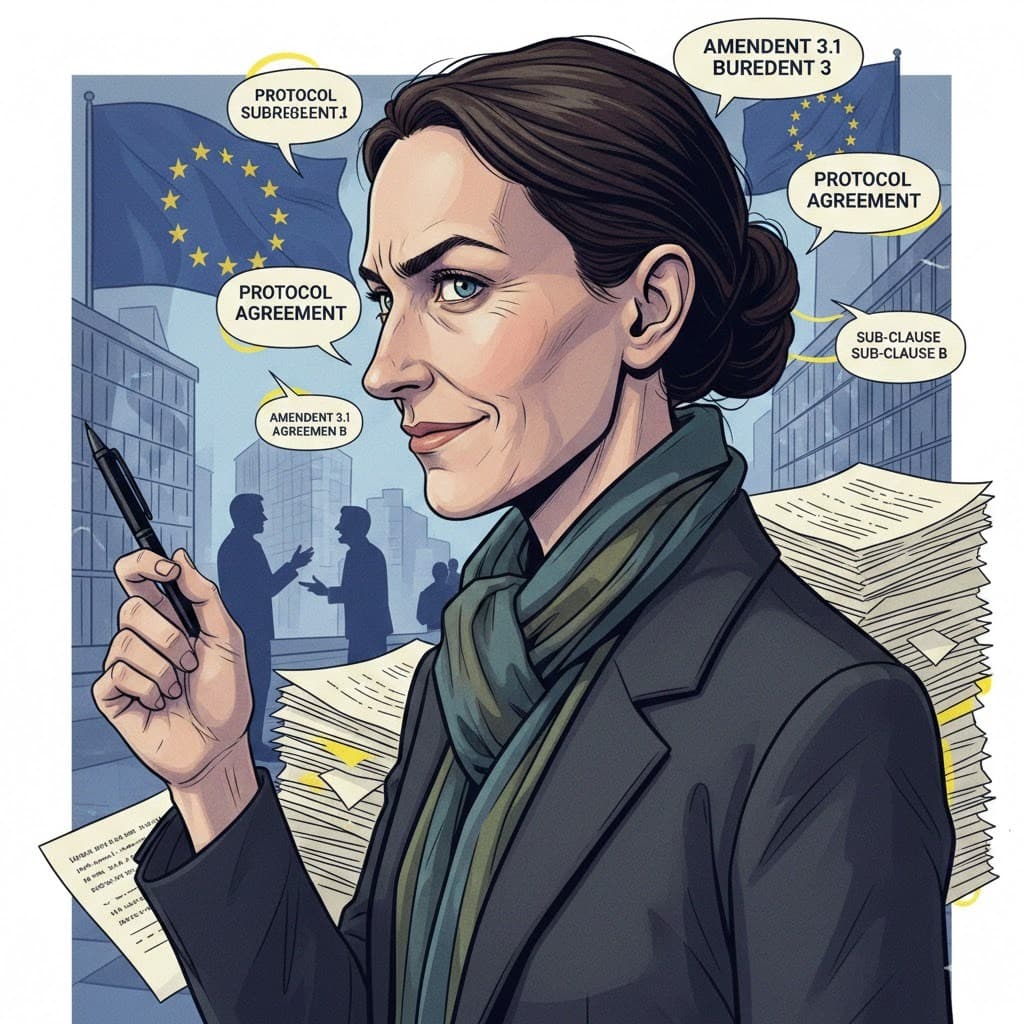

There is a particular brand of refined cruelty that only the European Union can truly master—the art of keeping a trade partner in the waiting room for twenty-five years, only to emerge from the inner sanctum and announce that the font on the contract is legally offensive. The latest development in the Mercosur saga is not merely a diplomatic hiccup; it is a symphony of bureaucratic inertia, a Wagnerian opera where the protagonist spends four hours deciding which shoe to put on first. European lawmakers have once again voted to block the free trade agreement with the South American bloc, citing 'legal concerns' with the grace of a Victorian dowager clutching her pearls at the sight of a slightly unpolished silver spoon.
To understand the sheer, magnificent absurdity of this situation, one must reflect on the timeline. Negotiations between the EU and Mercosur—comprising Brazil, Argentina, Paraguay, Uruguay, and more recently, Bolivia—began in 1999. To put that in perspective, when these talks commenced, the Euro was not yet a physical currency, the world was panicking about the Y2K bug, and most of the junior staffers currently drafting 'legal concerns' were still learning how to color within the lines. A quarter of a century has passed, and we are still debating the structural integrity of the bridge we haven't even begun to build. It is a testament to the European spirit: why achieve a geopolitical victory today when you can postpone it until the heat death of the universe in exchange for a few more subcommittee meetings?
The 'legal concerns' in question are, of course, the ultimate bureaucratic MacGuffin. They revolve around the legality of splitting the deal into different parts to bypass certain national parliaments. It is a classic European move: hiding a terrified protectionist instinct behind a thick, impenetrable layer of procedural righteousness. We are told the deal is a threat to the environment, a threat to French farmers, and a threat to the very soul of the continent. But instead of saying 'we are afraid of cheap steak,' the EU says 'we have profound reservations regarding the jurisdictional alignment of the supplementary protocols.' It is linguistic taxidermy—stuffing a dead argument with high-minded terminology and hoping it looks lifelike.
From my vantage point in a rapidly aging Europe, the spectacle is wearying. We watch as our lawmakers perform a surgical strike on their own credibility. The South American nations, having endured decades of lectures on the 'Rules-Based Order,' now find that the rules are a moving target, dancing away whenever a deal looks like it might actually be signed. One can almost see the Mercosur leaders standing at the docks, their crates of soy and beef slowly rotting, while they watch the EU Parliament debate whether the term 'sustainable development' has been used with sufficient frequency in the preamble. It is the diplomatic equivalent of a 'Waiting for Godot' sequel, but with more expensive suits and significantly less existential clarity.
The irony, dripping like acid through a lace doily, is that while Europe engages in this prolonged session of self-flagellation, the rest of the world is not waiting. While we obsess over the legal minutiae of a trade deal that predates the iPhone, other global powers—most notably China—are moving into South America with the efficiency of a predator in a petting zoo. They don't have 'legal concerns.' They have checks. They don't have twenty-five-year negotiation cycles; they have infrastructure projects. Europe, meanwhile, sits in its ivory tower, carefully polishing its regulations until they are so shiny that no one can actually use them.
This vote is a triumph for the status quo, which is to say, a triumph for decay. It represents the ultimate victory of the process over the product. In the hallowed halls of Brussels and Strasbourg, the goal is no longer to secure a future for the continent; the goal is to ensure that the paperwork is beyond reproach, even if the building is on fire. We have become a civilization of librarians who would rather see the books burn than allow them to be checked out with an incorrectly filled-in slip. We are told this block is about protecting the 'integrity' of the deal. It is a fascinating use of the word. Usually, 'integrity' implies a certain wholeness or strength. Here, it seems to mean a commitment to a perpetual state of 'almost.'
As a sophisticated European, I suppose I should be impressed by the stamina required to maintain a stalemate for two and a half decades. It takes a certain kind of intellectual rigor to find new ways to say 'no' to the same question since the Clinton administration. But as a world-weary observer of this collapsing theater, I find it difficult to summon anything but a sigh. We are the architects of our own irrelevance, meticulously drafting the blueprints for a fortress that will be finished long after the invaders have already moved in and changed the locks. The Mercosur deal isn't just a trade agreement; it's a mirror. And what it reflects back at us is a continent so in love with its own bureaucracy that it has forgotten how to breathe.
This story is an interpreted work of social commentary based on real events. Source: The Independent