The Damascus Rebrand: From IEDs to Hors d'oeuvres at the White House

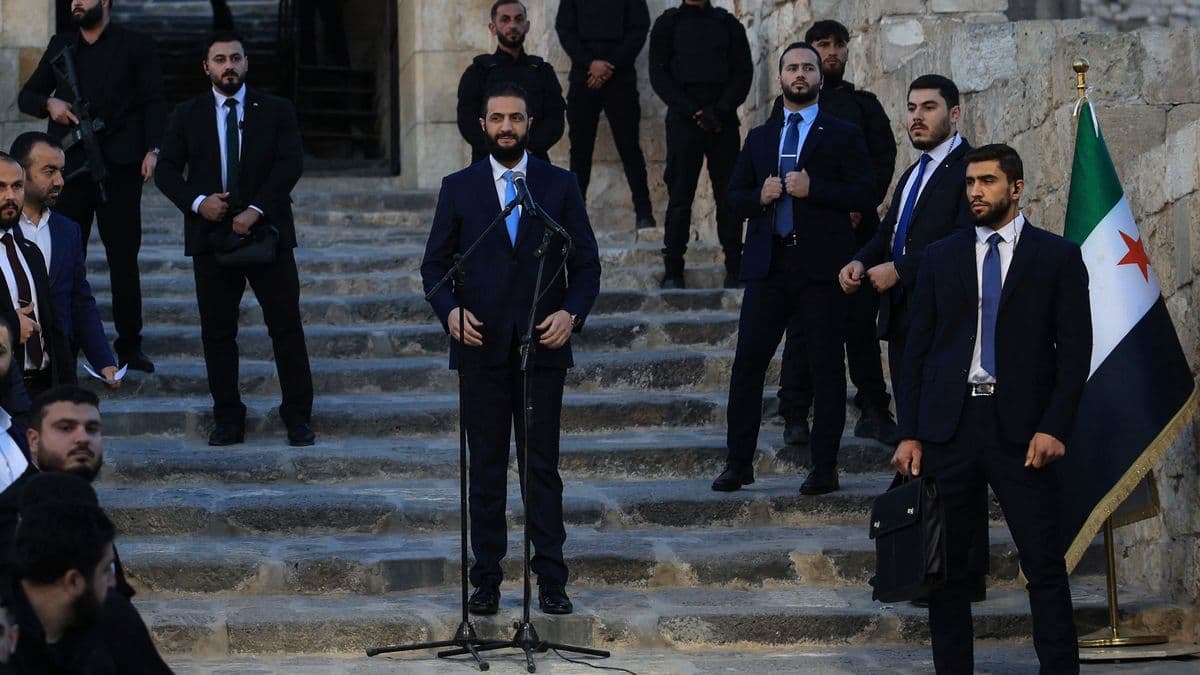
A year has passed since the Assad regime collapsed like a house of cards in a hurricane, and the world is currently pretending to be shocked that the vacuum has been filled by something other than a Scandinavian-style social democracy. Welcome to the new Syria, or as I like to call it, 'The Rebranding of the Century.' Our protagonist is Ahmed al-Sharaa, a man who has managed the singular feat of trading a suicide vest for a three-piece suit without once losing his appetite for absolute, crushing power. If you’re looking for a hero in this story, you’re in the wrong galaxy. This is a tale of how easily a 'global threat' becomes a 'strategic partner' when the West gets bored with its previous set of villains.
Twenty years ago, al-Sharaa—then known as the charmingly homicidal Jolani—was busy laying bombs to target Americans. Today, he is being received in the White House, likely sampling the kind of bite-sized appetizers that cost more than a Syrian villager’s annual income. It is the ultimate testament to the short-term memory of the American political machine, an entity with the cognitive retention of a goldfish on ketamine. The White House, that marble-clad temple of selective amnesia, has decided that the man who once viewed them as the Great Satan is now merely a misunderstood disruptor. It’s the geopolitical equivalent of dating the person who keyed your car because they’ve since taken a weekend seminar on 'leadership communication.'
The irony is thick enough to choke a horse. On the Left, we have the performative activists who spent years decrying 'imperialist intervention' only to now squint at al-Sharaa and try to find a narrative of 'indigenous liberation' in a man who would likely have them all arrested for their hairstyles. They want a revolution to be a clean, Instagrammable event, but instead, they’ve got a former jihadist who has discovered that the pen is mightier than the sword, mostly because the pen allows you to sign trade deals and execution warrants with the same flourish. They are desperate to believe that Syria is 'evolving,' ignoring the fact that the evolution of a predator usually just results in a more efficient way to kill.
On the Right, the moronic consistency is almost comforting in its stupidity. These are the same people who screamed about 'radical Islamic terror' for two decades, yet they are now perfectly happy to shake the hand of its former poster boy as long as he promises to be an 'enigma' that benefits their defense contractor stock portfolios. They don't care about the bombs of the past; they care about the stability of the present—a stability that is always, without fail, built on a foundation of shallow graves and broken promises. They see a man in a suit and see a 'moderate,' proving once again that the American conservative’s greatest weakness is a well-tailored blazer and a firm handshake.
And what of the 'Enigma of Damascus'? The enigma is that there is no enigma. Al-Sharaa is doing exactly what every other power-hungry narcissist in history has done: he is adapting to survive. He knows that to stay in power in the 21st century, you don't need to defeat the West; you just need to bore them until they accept you as the 'least worst' option. He has successfully navigated the 'terrorist-to-statesman' pipeline, a well-trodden path for those who realize that the White House doesn't care about your past as long as your future involves keeping the 'wrong' kind of people quiet. He is leading Syria exactly where it was always going—into another era of autocratic rule, just with better PR and perhaps a more efficient bureaucracy for suppressing dissent.
The Syrian people, meanwhile, remain the involuntary extras in this tedious blockbuster. They’ve swapped a secular torturer for a religious one who has learned how to use LinkedIn. The 'freedom' they were promised is the freedom to choose which specific flavor of extremist will be monitoring their internet usage. It is a cynical, grinding cycle that proves humanity's primary export is misery, packaged in different colored wrapping paper every few decades. We watch this farce from our comfortable distance, nodding along to the 'analysis' of experts who couldn't find Damascus on a map if it was highlighted in neon, while the man who used to plant bombs now plants himself at the table of global power. It’s not an enigma; it’s a punchline, and we’re the ones being laughed at.
This story is an interpreted work of social commentary based on real events. Source: Der Spiegel