The Greenland Shiver: Global Markets Rediscover Their Own Irrelevance in a Melting World

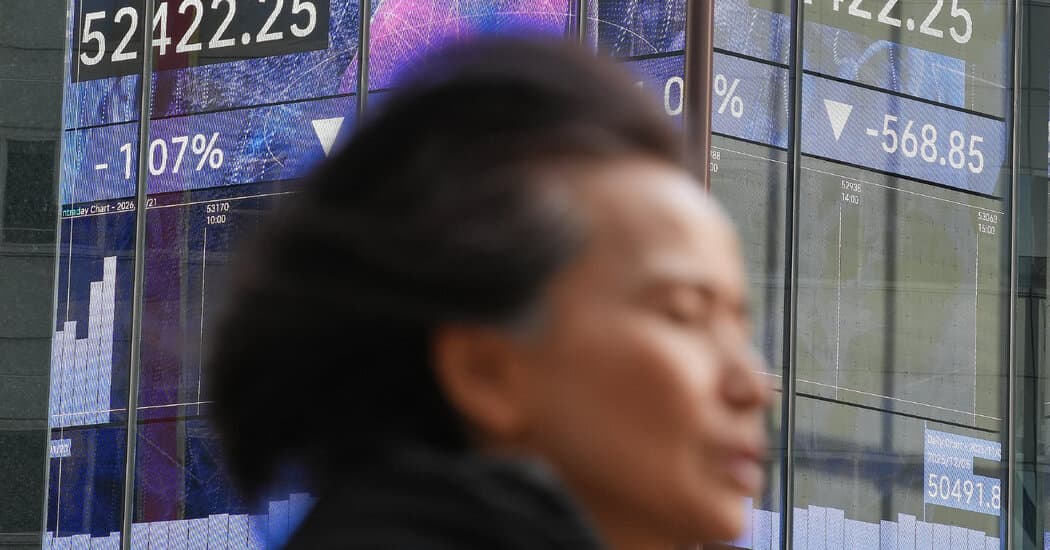
The financial world, that grand, shimmering cathedral built entirely of leveraged hot air and the desperate hopes of people who believe numbers on a screen are a substitute for a soul, has decided to have its latest collective nervous breakdown. This week, the 'relative calm'—a phrase used by financial pundits to describe the brief period where they successfully distract the public from the looming abyss—was shattered. The catalyst? A slump in U.S. stocks that successfully migrated across the oceans like a particularly virulent strain of stupidity, infecting markets in Asia and Europe. And at the center of this latest tantrum lies Greenland, a giant block of ice that remains the only thing on Earth colder than the hearts of the hedge fund managers currently weeping over their portfolios.
Let’s be clear about what 'market volatility' actually is: it is the sound of the world’s wealthiest grifters realizing that their house of cards is sensitive to a breeze. The U.S. markets, the bloated, diabetic engine of global commerce, finally twitched. It wasn't a 'correction' or a 'strategic realignment.' It was an admission of the bankruptcy of spirit that defines modern economics. For months, the investor class has been coasting on a cloud of artificial intelligence hype and the naive belief that the Federal Reserve could somehow engineer a soft landing into a bed of marshmallows. Instead, they’ve realized that the global economy is more like a Jenga tower being played by a toddler in the middle of an earthquake.
The spillover into Asia and Europe is the most predictable part of this tragicomedy. This is the ultimate beauty of globalism—universal suffering. We have painstakingly constructed a world where a bad day for a tech bro in Menlo Park translates directly into a catastrophe for a salaryman in Tokyo or a pension fund in London. It is a beautiful, interconnected web of failure. When the American consumer decides to stop buying plastic junk they don't need with money they don't have, the entire planet feels the shudder. The markets in Asia and Europe didn't drop because of some fundamental shift in value; they dropped because they are tethered to the American carcass, and when the carcass rots, everyone gets a whiff.
Then there is the Greenland factor. The strategic 'tensions' over this melting landscape are the perfect metaphor for the 21st century. We are watching the world’s superpowers fight over the wreckage of a dying planet to see who gets to sell the last bottle of water. The Arctic is the new frontier for people who have already ruined every other habitable inch of the globe. The Left will issue performative press releases about 'sustainable development' and 'indigenous sovereignty' while their donors quietly buy up Arctic shipping routes. The Right will scream about 'national security' and 'territorial integrity' while drooling over the prospect of strip-mining the permafrost for rare earth minerals to build the batteries for the electric vehicles that are supposedly saving the planet. Both sides are fundamentally indistinguishable in their desire to squeeze one last cent out of the ice before it turns into a lukewarm puddle.
To the average person, this 'rattle' in the markets means very little beyond the creeping realization that their retirement fund is a fiction maintained by people who couldn't tell you the difference between a subprime mortgage and a hole in the ground. The markets will 'stabilize,' of course. They always do. We will return to the quiet, steady hum of our own irrelevance until the next 'rattle' occurs. The pundits will return to their charts, drawing lines that suggest they understand the chaos of human greed, and the politicians will return to their podiums to blame the other side for the inherent instability of a system they both profit from.
In the end, the Greenland tensions are just a reminder that the world is a cold, indifferent place, and the global economy is just a fever dream we’ve all agreed to have together. The ice will continue to melt, the markets will continue to fluctuate based on the mood swings of bored algorithms, and humanity will continue to march toward the horizon, convinced that if we just find one more mineral deposit in the Arctic, everything will finally be okay. It won't be. But at least the charts will look interesting on the way down.
This story is an interpreted work of social commentary based on real events. Source: NY Times