The Straight Line to Nowhere: Spain’s High-Speed Hubris Meets the Inevitability of Physics

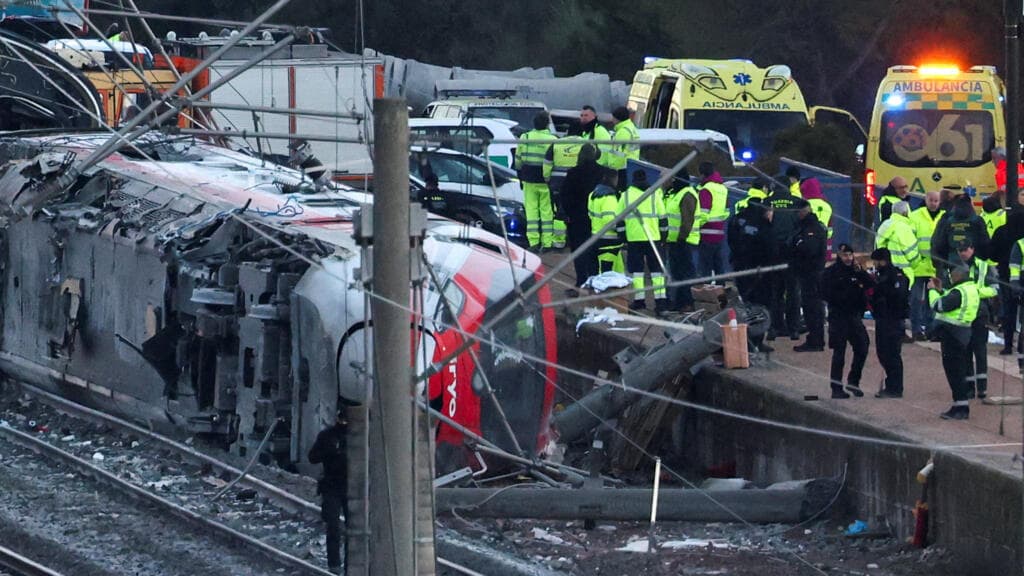
There is something deliciously ironic about the human obsession with the straight line. We spend centuries trying to iron out the wrinkles of the earth, laying down ribbons of steel so we can hurtle ourselves toward our inevitable demise at several hundred kilometers per hour, all while sipping lukewarm espresso in a pressurized cabin of false security. This past Sunday night in southern Spain, the universe decided to remind us that no matter how straight the track or how shiny the locomotive, gravity and incompetence remain the only truly reliable forces in our decaying civilization. The high-speed rail network in Spain—touted as the crown jewel of European infrastructure, a sprawling, tax-funded monument to the idea that we can outrun time itself—has finally yielded the only result that matters: a pile of expensive, smoldering scrap metal and a body count that demands a moment of silence from the very bureaucrats who approved the budget.
Thirty-nine people are dead. More than one hundred and twenty are injured. And the 'experts,' those high-priests of the slide rule and the safety audit, are 'surprised.' One wonders what it actually takes to un-surprise an expert these days. Apparently, a train derailing on a perfectly straight piece of track while operating with 'relatively new' technology is the one thing they didn't account for in their glossy PowerPoint presentations. To the professional observer of human folly, this isn't a surprise; it's a structural guarantee. When you build the largest high-speed network in Europe, you aren't building a transportation system; you’re building a larger, faster way for things to go wrong. The fact that this occurred on a straight stretch of track is the ultimate middle finger from reality to the engineers who thought they had mastered the geometry of safety.
We are told the train was 'relatively new.' This is a phrase designed to comfort the masses, as if the smell of fresh upholstery and the lack of rust on the exterior somehow grants immunity from the laws of motion. In reality, 'new' in the world of government-contracted infrastructure usually just means the software hasn't been properly stress-tested by anything more demanding than a sunny afternoon and a light breeze. The collision, which saw one high-speed marvel tear into another like a toddler smashing toys together, proves that our technological reach has far exceeded our intellectual grasp. We are monkeys playing with lightning, and we’re shocked—truly shocked—when we get burned.
The suspension of high-speed services across the region is the predictable, bureaucratic reflex. It is the administrative equivalent of closing the barn door after the horse has already been turned into glue. It allows the authorities to look busy, to issue grim statements in expensive suits, and to pretend that they are 'investigating' a phenomenon that is as old as the steam engine: the fact that complex systems fail in direct proportion to their complexity. They will look at the black boxes, they will analyze the signal data, and they will eventually blame a sensor or a single overworked technician. They will never admit that the entire philosophy of high-speed transit is a frantic, expensive flight from the reality of our own limitations.
Southern Spain, now the site of this mangled wreckage, serves as a backdrop to a very European kind of tragedy—one where the veneer of modern efficiency is peeled back to reveal the same old chaos beneath. The Left will cry for more regulation, as if a few more binders of rules could have held that train to the tracks. The Right will grumble about the costs and the efficiency of the state-run network, as if privatizing the disaster would have made the impact any softer. Both sides are, as usual, missing the point. The point is that we have built a world where we are too fast to survive our own mistakes. We have created a society that values the 'straight line' above all else, forgetting that life is a series of curves, most of which lead to a ditch.
As the smoke clears and the service suspension drags on, the public will wait. They will wait for the 'all-clear,' for the experts to tell them it’s safe to climb back into the glossy metal coffins and resume their 300km/h commute to nowhere. And they will do it. Because the only thing humans fear more than a high-speed collision is the prospect of having to slow down and actually look at the world they’ve built. We would rather die in a state-of-the-art derailment on a straight track than admit that our progress is just a faster way to reach the end of the line. So, let the experts remain surprised. It is the only honest emotion they have left in a world that has finally outrun its own sanity.
This story is an interpreted work of social commentary based on real events. Source: RFI