The Final Cubicle: Scott Adams Exits the Simulation via Social Media Livestream

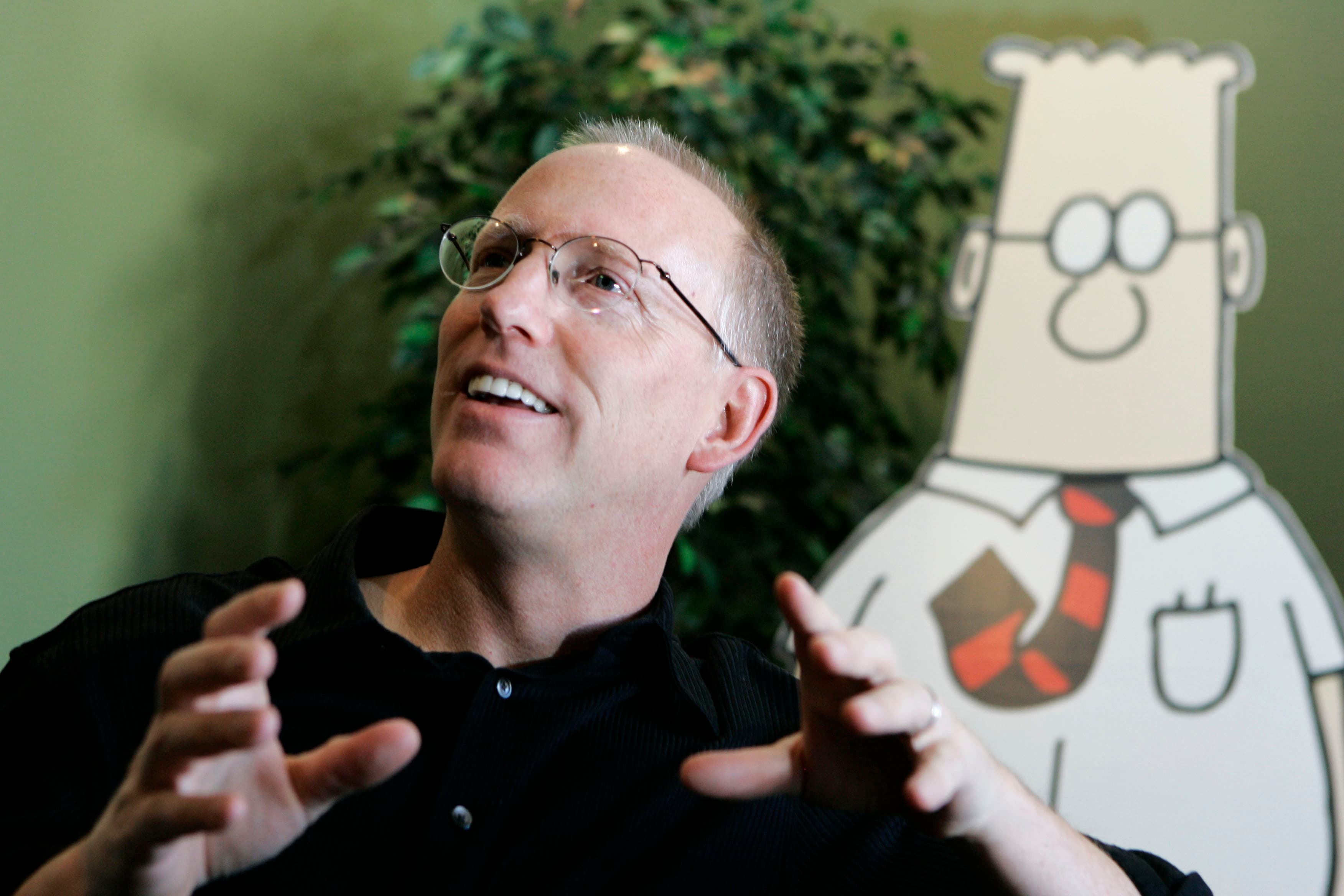
The tie has finally gone limp. Scott Adams, the man who managed to monetize the collective sigh of the American workforce for three decades before deciding to set his own career on fire for the digital equivalent of magic beans, is dead at 68. The announcement of his passing didn't come via a dignified obituary or a solemn press release. Instead, it arrived in the most fittingly pathetic manner possible for the 21st century: via a social media livestream hosted by his first ex-wife, Shelly Miles. There is something poetically hideous about a man who spent his final years obsessed with 'persuasion' and 'frames' ending his run as a pixelated notification on a platform designed to harvest the attention of the bored and the braindead.
For those who haven't been paying attention to the slow-motion car crash of Adams’ public persona, he was once the high priest of the office-dwelling mid-wit. 'Dilbert' wasn't just a comic strip; it was a sedative. It allowed millions of corporate drones to feel like they were part of a secret, cynical resistance while they continued to fill out their TPS reports and endure mandatory synergy seminars. Adams understood the fundamental truth of the American workplace: that it is a theater of the absurd run by people who failed upwards. But he didn't want to burn the theater down; he just wanted to sell tickets to the people sitting in the back row. He became a multi-millionaire by poking fun at the very bureaucracy that funded his lifestyle, a feat of parasitic brilliance that even the most ruthless CEO could admire.
But the cubicle wasn't enough for Adams. Bored by his own success and seemingly desperate for the kind of intellectual validation that a two-dimensional engineer couldn't provide, he pivoted. He decided he was a 'Master Persuader.' He traded his drawing board for a webcam and a bunker-like setting, spending hours explaining to the internet why the world was actually a 4D chess match that only he and a handful of political demagogues understood. He became a fixture of the reactionary right, not because he possessed any profound ideological conviction, but because the Right is always desperate for a 'creative' who doesn't openly despise them, and the Left had already sharpened their guillotines the moment he stopped being 'relatable' and started being 'difficult.'
The reaction to his death will be, as always, a symphony of stupidity. On the Left, we will see the performative gravedancing—a desperate scramble to see who can tweet the most 'witty' condemnation of a dead man's later-life rants. They will frame his demise as a moral victory for 'progress,' as if the passing of a 68-year-old cartoonist somehow balances the scales of social justice. They are children playing with matches in a room made of paper. On the Right, Adams will be canonized as a martyr of 'Cancel Culture,' a visionary who was silenced by the woke mob. They will ignore the fact that his 'silencing' mostly consisted of him losing syndication deals because he told his audience to stay the hell away from Black people—a take so radioactive it would make a 1950s segregationist squint. They don't care about his art; they care about his utility as a weapon in a culture war that neither side has the intellect to win.
Historically, we see this pattern repeat with the regularity of a ticking clock. The court jester, having spent too long mocking the king, eventually begins to believe he is the one who should wear the crown. Adams forgot that his power lay in the Everyman, not the Superman. He traded the universal relatability of 'the Monday morning blues' for the niche toxicity of the grievance-industrial complex. His death marks the end of an era, not of cartooning, but of a specific kind of American success story: the one where you win the game, get the money, and then spend the rest of your life trying to convince everyone that you’re actually a philosopher-king rather than just a guy who got lucky with a joke about a talking dog.
Ultimately, the death of Scott Adams changes nothing. The cubicles remain. The pointy-haired bosses are still being promoted. The 'synergy' is still being leveraged. We are all still trapped in the same grinding machinery of corporate existence that Adams once expertly skewered, only now we don't even have a daily comic strip to help us swallow the bile. We are left with the digital residue of a man who thought he could hack reality and ended up just another casualty of the very outrage cycles he tried to manipulate. The simulation continues, the livestream ends, and the world remains as stubbornly, aggressively stupid as it was the day Dilbert first put on his tie.
This story is an interpreted work of social commentary based on real events. Source: Politico