The Great British Reskin: Why Reform UK is Just the Same Old Rot with a New Paint Job

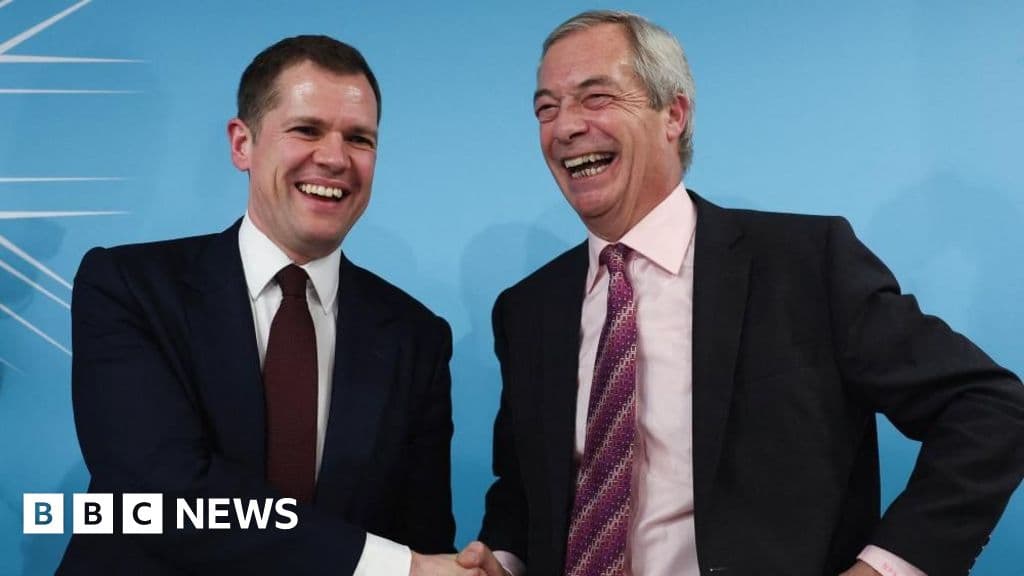
The British political landscape is currently resembling a high-stakes game of Three-card Monte played in a flooded basement. On one side, we have the Conservative Party, a group of individuals who have spent the last decade demonstrating that 'governance' is merely a synonym for 'organized looting with better tailoring.' On the other, we have the emergence of Reform UK, led by the perennial ghost of Christmas Past-Future, Nigel Farage. The BBC’s Chris Mason, in a fit of professional curiosity that borders on the masochistic, has raised the question of whether Reform is simply 'Conservatives 2.0.' It is an inquiry that suggests there is something new under the sun, rather than just the same old rot being turned over with a different shovel.
To speak of 'momentum' and 'magnetism' in the context of Nigel Farage is to celebrate the gravitational pull of a black hole. It is undeniably strong, yes, but its primary function is the total annihilation of everything that crosses its event horizon. Farage is the political equivalent of a recurring rash; just when you think you’ve applied enough ointment to the national psyche, he flares up again, usually in a pub, holding a pint and pretending to be 'the common man' despite having the pedigree of a stockbroker and the temperament of a bored aristocrat. The 'magnetism' isn't a testament to his virtue; it’s a testament to the absolute vacuum left by the collapse of the two-party system. When the center cannot hold, people don't look for a better center; they look for the loudest man in the room with the shiniest tie.
The branding of Reform as 'Conservatives 2.0' is particularly hilarious to anyone who has ever had to endure a software update. Usually, a 2.0 version implies some level of optimization, a patching of bugs, perhaps a more user-friendly interface. But in the British political laboratory, 2.0 just means the same bugs have been promoted to features. The Tories have spent years failing to manage the very borders they obsessed over, failing to ignite the economy they worshipped, and failing to convince anyone that they weren't just a collection of warring ego-clusters. Reform UK looks at this wreckage and decides the problem wasn't the failure itself, but that the failure wasn't loud enough. They are the Tories with the safety catch removed and the volume turned up to eleven. It is not an evolution; it is a mutation born of desperation and ideological exhaustion.
This 'momentum' Mason speaks of is essentially the sound of the electorate giving up. When people realize the main course is poisoned, they start looking at the garnish with renewed interest. Reform is the garnish. It’s a sprig of wilted parsley on a plate of radioactive waste. The voters, driven by a mixture of justified spite and a total lack of imagination, are flocking to a party that promises 'Reform' without ever quite explaining what that looks like beyond a vague sense of returning to a mythical past that never actually existed outside of a mid-century bread commercial. It’s the ultimate grift: selling nostalgia to people who have no future, using a vehicle built from the spare parts of the party they claim to despise.
And what of the opposition? The Left watches this with a blend of performative clutching of pearls and internal glee, hoping that the Right will cannibalize itself so thoroughly that they can sleepwalk into power by default. They offer no counter-magnetism, only a slightly more polite version of the same managed decline. They are the bystanders at a car crash, taking selfies with the wreckage while complaining about the traffic. It is a pathetic spectacle on all fronts. The Tories are the exhausted incumbents of a bankrupt store, and Reform is the guy standing on the sidewalk shouting that he can sell you the same broken goods for half the price if you just give him your soul and ignore his previous seven failed business ventures.
The reality is that British politics has become a closed loop of mediocrity. Whether it’s the original brand or the 2.0 iteration, the product remains the same: a deep-seated commitment to the preservation of the status quo while pretending to burn it down. Farage isn't a revolutionary; he’s a landlord who knows the building is condemned and is trying to collect one last month’s rent before the whole thing collapses. The 'magnetism' Mason describes is merely the sound of the drain swirling. We are witnessing the final, desperate rebranding of a failed ideology, and the only truly 'reformed' thing will be the speed at which the country hits the bottom of the pit. To call it 2.0 is an insult to the number two, and to the concept of progress in general. It is the same old circus, just with a new tent and the same tired clowns.
This story is an interpreted work of social commentary based on real events. Source: BBC News