Washington’s New BFF: The State Department’s Desperate, Cringe-Inducing Pivot to Theocracy in Dhaka

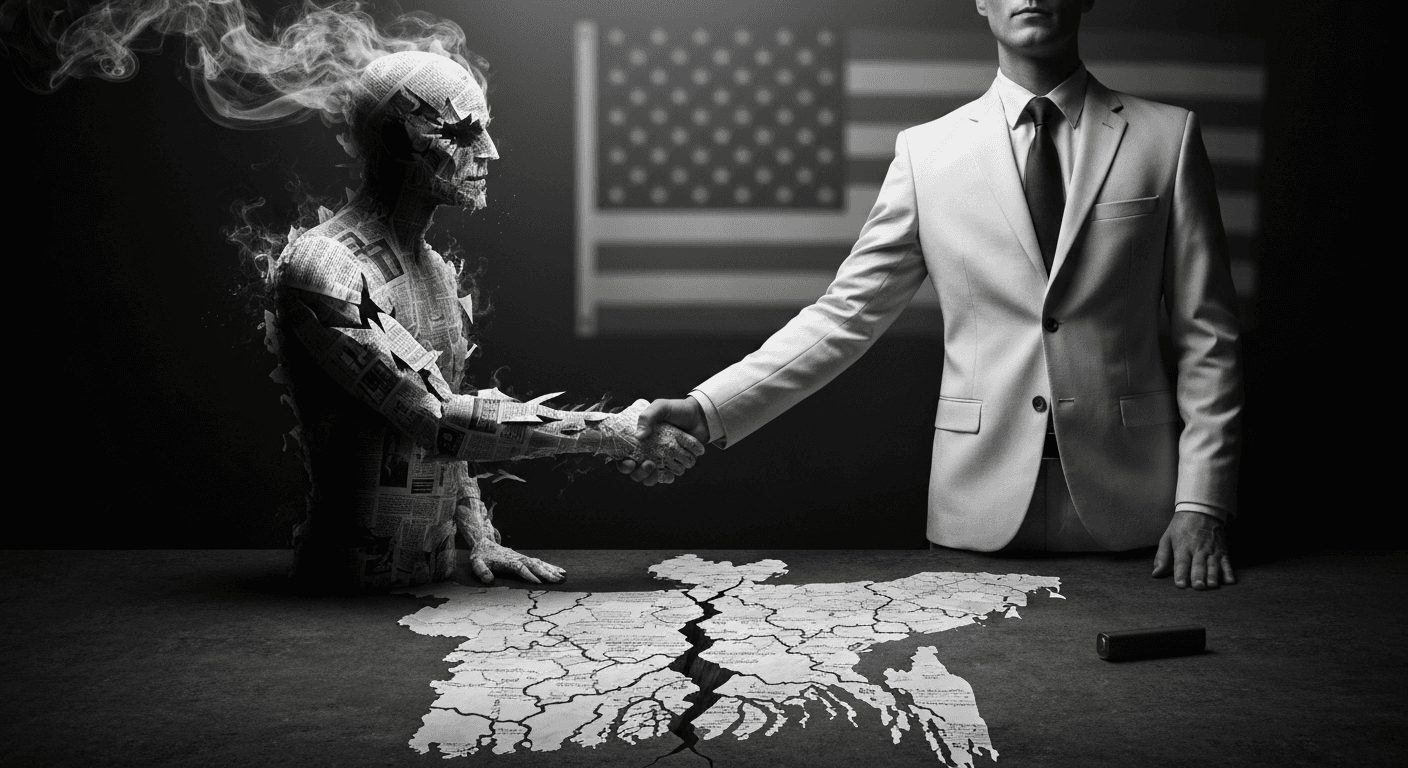
There is a specific kind of nausea reserved for observing American foreign policy in the twenty-first century. It isn’t the nausea of shock—because, frankly, nothing the United States government does is shocking anymore to anyone paying attention. It is the bile-rising realization that the global hegemon is not run by evil geniuses playing four-dimensional chess, but by desperate mid-level bureaucrats trying to hit quarterly engagement metrics by 'friending' the very entities they spent the last two decades demonizing. The empire isn’t collapsing with a bang; it’s collapsing with a leaked audio recording of a diplomat trying to sound like a guidance counselor for political extremists.
Case in point: Bangladesh. Specifically, the recent revelation that Washington is now actively seeking to be “friends” with Jamaat-e-Islami. Yes, that Jamaat-e-Islami. The organization that opposed the very birth of Bangladesh in 1971, that has been historically linked to gruesome violence, and that was, until quite recently, treated by the West as a radioactive isotope in the periodic table of South Asian politics. But apparently, in the hollow corridors of the State Department, memory is a depreciating asset. The Global War on Terror is over, folks. It’s been rebranded. Now, it’s the Global War of Finding Someone, Anyone, Who Will Pick Up Our Phone Calls.
The absurdity of the word “friends” in this context cannot be overstated. In the leaked audio, the U.S. diplomat speaks with the casual, agonizing optimism of a freshman trying to rush a fraternity that hates him. “We do not see Jamaat as a banned organization,” the voice says, effectively whitewashing decades of history with a single sentence of bureaucratic semantic gymnastics. It is a masterclass in the American art of the pivot—a maneuver so shameless it would be impressive if it weren't so pathetic. For twenty years, the U.S. exported a narrative that Islamist fundamentalism was the existential threat to civilization. We invaded countries, droned weddings, and established black sites based on this premise. Now? Now the strategy is apparently to invite them over for tea and biscuits because the previous secular autocrat in Dhaka—who the U.S. also supported until she became inconvenient—fled the country.
Let’s analyze the motivations here, if we can stoop low enough to find them. Why is Washington suddenly swiping right on theocracy? Is it a genuine belief in the pluralistic democratic process? Don’t make me laugh; my lips are too chapped from sneering. The United States cares about democracy in the same way a butcher cares about animal welfare—strictly as a marketing term. No, this is about leverage. It is about the frantic need to maintain a foothold in a region where China is buying up ports and infrastructure like they’re going out of style. The U.S. logic is simple, binary, and stupid: The enemy of my enemy is my friend, even if my new friend thinks civil liberties are a Western disease.
And then there is the India factor. Watching New Delhi react to this is the only source of grim amusement in this entire debacle. For years, the U.S. has been courting India as the great counterweight to China—the “Quad,” the defense deals, the endless state dinners. Yet, here is Washington, casually stabbing India in the back by legitimizing a group that New Delhi views as a direct security threat. It is the geopolitical equivalent of cheating on your spouse with their worst enemy and then claiming you did it to save the marriage. India is furious, and rightfully so, though their own hands are hardly clean in the region. But it exposes the fundamental lie of the “U.S.-India Strategic Partnership.” There is no partnership. There are only interests, and currently, the U.S. is interested in stirring the pot in Dhaka, regardless of who gets burned next door.
This “engagement” strategy reveals the utter hollowness of Western liberal internationalism. We are told, constantly, that the U.S. stands for human rights, for secularism, for the protection of minorities. Yet, when the rubber meets the road, the State Department is perfectly happy to legitimize a party with a history of sectarianism if it means sticking a thumb in the eye of a rival or securing a temporary tactical advantage. It is a transactional nihilism that masquerades as diplomacy.
The diplomat in the recording suggests that this new friendship is about “moving forward.” But forward to what? To a Bangladesh where the U.S. helps install a new flavor of authoritarianism, just to keep the seat warm until the next coup? The arrogance is breathtaking. Washington assumes it can ride the tiger of religious fundamentalism without getting eaten. History—from the Mujahideen in the 80s to the various militias in the Middle East—suggests otherwise. The U.S. has the reverse Midas touch: everything it attempts to “manage” turns to lead and blood.
So, congratulations to Jamaat-e-Islami. You’ve been friend-zoned by the United States of America. Enjoy the attention while it lasts. Soon enough, the winds in Washington will shift, the metrics will change, and you’ll find yourselves back on the naughty list. But for now, enjoy the farce. The rest of us are forced to watch, repulsed, as the world’s superpower flails around in the dark, shaking hands with phantoms and calling it progress.
This story is an interpreted work of social commentary based on real events. Source: Washington Post