Prehistoric Narcissism: Oldest Cave Art Proves We’ve Been Vapid Attention-Seekers for 68,000 Years

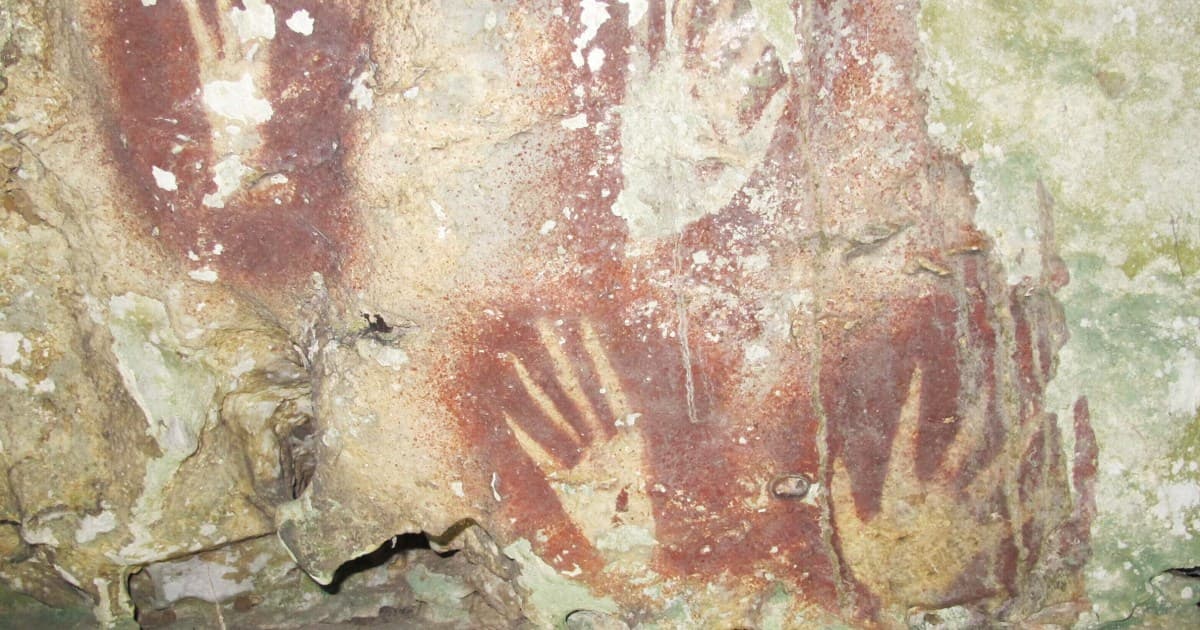
Congratulations, humanity. We have finally unearthed the ultimate receipt for our species' enduring, insufferable vanity. Researchers in Indonesia have discovered the world’s oldest known example of cave art, a hand stencil dating back at least 67,800 years. While the scientific community is undoubtedly hyperventilating into paper bags over the 'cultural significance' of this find, let’s call it what it actually is: the Paleolithic equivalent of a bathroom stall scribble. It is the first recorded instance of a human being—or at least a hominin close enough to count—screaming into the void, 'Look at me, I exist, and I have five fingers, unlike that loser Thag who got eaten by a tiger last week.'
This discovery in Sulawesi doesn't prove that our ancestors were deep, philosophical artisans contemplating the nature of existence. It proves that the urge to vandalize nature with our own likeness is the only consistent trait in our genetic code. Before we invented fire, the wheel, or the concept of compound interest, we invented the 'selfie.' That is essentially what this hand stencil is. It is a desperate, pathetic attempt to curate a personal brand before the concept of a brand—or a person, really—had even fully coalesced. The artist, if we must degrade that word by using it here, placed their hand against the cold stone, blew some red ochre pigment over it, and stepped back to admire the outline of their own ego.
Let’s dissect the sheer mediocrity of the medium. We aren’t talking about the Sistine Chapel here. We aren’t even talking about a crude stick figure hunting a buffalo, which would at least imply a narrative or a reverence for the food chain. No, this is literally just a hand. It is the absolute minimum effort required to leave a mark. It is the prehistoric version of a corporate logo—simple, reproducible, and devoid of soul. It says nothing about the world the artist lived in. It tells us nothing about the struggles of the epoch, the terror of the night, or the joy of the hunt. It only tells us that 68,000 years ago, someone had a hand and enough spare time to act like a toddler with a finger-painting set. And we are supposed to be impressed?
Think about the timeline. Nearly 68,000 years. That is a staggering amount of time for humanity to have evolved absolutely zero percent in terms of emotional maturity. You can walk into any dive bar in America, navigate to the men's room, and see the exact same impulse scratched into the paint above the urinal. 'Dave was here.' 'For a good time call...' It is the same biological imperative that drove that ancient Indonesian cave dweller to spit pigment on a wall. We are terrified of being forgotten. We are terrified that our brief, miserable flash of consciousness will be extinguished without a trace. So, we slap our names, our faces, and our handprints onto anything that looks like it might last longer than we will. It is pathetic. It is fear masquerading as expression.
The researchers involved in this study are treating the find as a 'game-changer' for our understanding of human migration and cognitive development. They argue that this proves early humans possessed the capacity for abstract thought much earlier than previously believed. Oh, please. Is realizing that your hand blocks spray paint really 'abstract thought'? Or is it just basic physics understood by anyone who has ever stood in front of a light source and made a shadow puppet? We set the bar so low for our ancestors because it makes us feel better about our own current stupidity. If we can convince ourselves that blowing red dust on a rock was a stroke of genius in the Late Pleistocene, maybe we can convince ourselves that posting a picture of our brunch on Instagram is 'content creation' today.
Furthermore, consider the location. This was found in Indonesia, shattering the Eurocentric delusion that art began in the caves of France or Spain. While it is always amusing to watch European academics squirm as their precious narrative of cultural supremacy crumbles, let’s not pretend this elevates the rest of the world to some lofty height. It just means that idiocy and ego were globally distributed long before globalism was a buzzword. The instinct to deface the natural world is not a Western invention; it is a human defect. We spread out of Africa, and the first thing we did upon arriving in Southeast Asia was look for a blank canvas to ruin.
Ultimately, this hand stencil is a monument to our own insignificance. That hand belonged to someone who lived, breathed, probably suffered from gum disease, and died. Their name is lost. Their children are dust. Their entire culture has been ground into nothingness by the millstone of geologic time. All that remains is a negative space where a hand used to be—a literal void outlined in fading red. It is the perfect metaphor for the human condition. We spend our lives trying to fill the empty space, trying to outline ourselves against the universe, but in the end, we are just the absence of rock where the pigment didn't land. The rock is still there. The pigment is still there. The human is gone. And 68,000 years later, we are still staring at the wall, clapping like seals, pretending that this hollowness is profound.
This story is an interpreted work of social commentary based on real events. Source: NBC News