He Jiankui: Because Prison is Just a Sabbatical for Amateur Gods

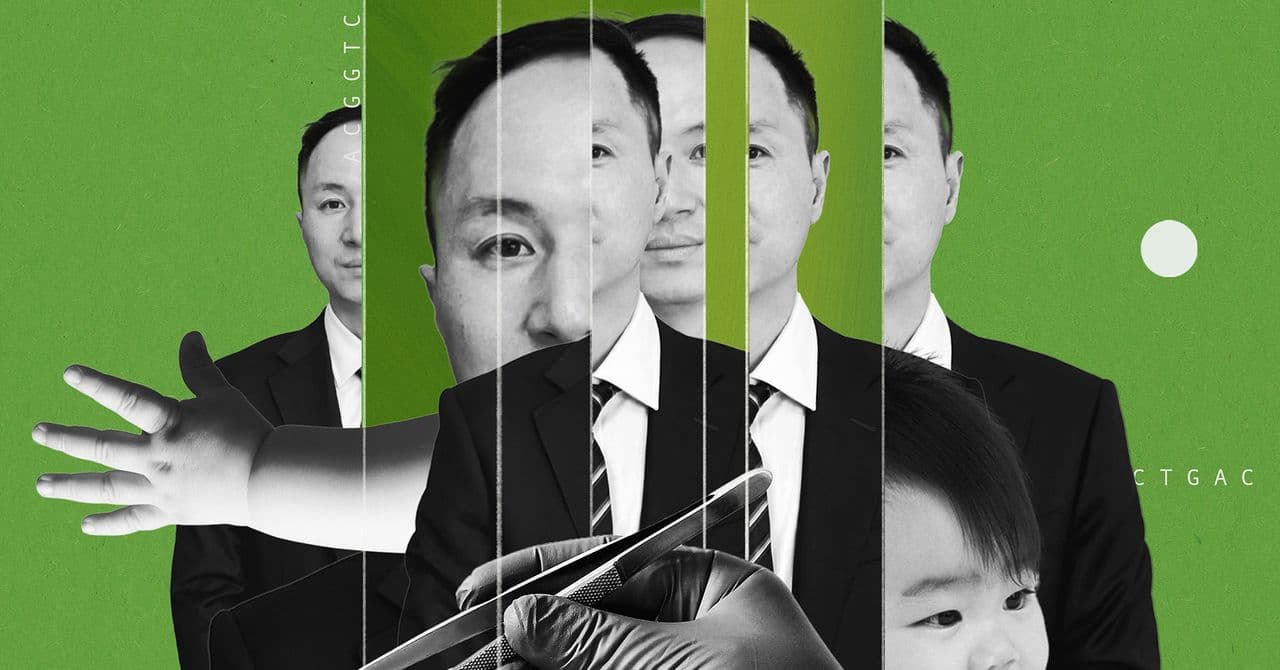
Oh look, the biological vandal is back from his state-sponsored timeout. He Jiankui, the man who decided that humanity’s genetic code was a first draft in desperate need of an unsupervised intern’s red pen, has emerged from a Chinese prison with all the humility of a toddler who just figured out how to use a blowtorch. After a brief three-year hiatus for the minor social faux pas of illegally creating the world’s first CRISPR-edited babies, He is back on the scene, peddling a new brand of salvation. Because if there’s one thing the world needs right now, it’s a convicted felon with a God complex tinkering with the blueprint of the species once again while the rest of us are still trying to figure out how to keep our passwords secure.
His new mission? Curing Alzheimer’s. It’s a masterstroke of PR. Who could possibly argue against curing a disease that robs people of their memories and dignity? It’s the ultimate shield for a man whose previous work was less 'medical breakthrough' and more 'extinction-level event waiting to happen.' He’s pivoted from the reckless 'enhancement' of infants to the noble 'protection' of the elderly. It’s a classic rebrand, the kind usually reserved for oil companies after an ocean-destroying spill or disgraced tech CEOs after a massive data leak, but applied to the very fabric of human existence. He isn’t just editing genes; he’s editing his own narrative, hoping we’ve all developed the very dementia he claims to be fighting. It’s a level of intellectual gaslighting that would be impressive if it weren't so transparently self-serving.
In a move that would be hilarious if it weren't so nauseatingly hypocritical, He has taken aim at the tech bros of Silicon Valley. He recently characterized their longevity efforts—specifically the ones involving blood transfusions from the young and obsessive calorie counting—as a 'Nazi eugenic experiment.' It’s the kind of projection that deserves its own wing in the Louvre. Here we have a man who bypassed every ethical board on the planet to play Russian Roulette with the germline of future generations, clutching his pearls because some billionaire in Palo Alto wants to live forever on a diet of kale and existential dread. It’s a battle of the narcissists: the basement biohacker versus the venture capital vampires. They both want the same thing—to cheat death and play architect to a 'superior' humanity—but they’re squabbling over who gets to wear the white lab coat while they do it. The Right will undoubtedly see his 'innovation' as a triumph of individual will over government regulation, while the Left will wring their hands over 'genetic equity' while secretly hoping they can afford the treatment. Both sides are idiots.
The sheer, unadulterated gall of it is breathtaking. The scientific community, a group of people who usually can't agree on lunch, was unified in its horror when He first announced Lulu and Nana. Yet, here we are, watching him set up a new lab, court investors, and tweet about his 'vision.' It proves that in our current cultural wasteland, there is no sin so great that it can’t be washed away by the promise of a technological silver bullet. We are a species so terrified of our own mortality and so bored by our own mediocrity that we are willing to hand the keys to the kingdom to any charismatic lunatic with a pipette and a dream. We have replaced religion with a blind faith in the laboratory, assuming that because we *can* edit the code, we *should*.
Let’s be clear: He Jiankui doesn’t care about Alzheimer’s in any altruistic sense. He cares about being the man who 'solved' it. He craves the legacy, the recognition, and the absolute power that comes with being the first to successfully rewrite the human script. The fact that his previous 'experiment' resulted in children whose long-term health is a giant, glowing question mark seems to be a mere footnote in his grand plan. He treats the human genome like a piece of buggy software that just needs a quick patch, ignoring the fact that the 'code' has been compiled over millions of years of evolution and that his 'fix' might just crash the entire system beyond repair. It’s the height of hubris, a modern-day Tower of Babel built out of nucleotides and ego.
And why shouldn't he? We live in an era where expertise is treated as a slur and 'disruption' is worshiped as a religion. If you aren't breaking things—even if those things are the fundamental building blocks of life—you aren't trying hard enough. The global political machine is too slow, too stupid, and too corrupt to stop him. While politicians argue over bathroom bills and trade tariffs, He Jiankui is in the lab, deciding what the next generation of humans will look like. It’s a terrifying prospect, but we’re too distracted by our glowing screens to notice the man behind the curtain with the CRISPR kit.
In the end, He Jiankui is the perfect mascot for the 21st century. He is arrogant, unrepentant, and utterly convinced of his own righteousness. He represents our collective delusion that we can innovate our way out of the human condition. We don’t want to fix our society, our habits, or our environment; we want to fix our meat. We want to delete the parts of ourselves that remind us of our fragility. And as He Jiankui prepares to dive back into the gene pool, he isn't just looking for a cure; he’s looking for a way to ensure that his name is written into the very marrow of the future. It’s not science; it’s a vanity project with a potential body count. But please, by all means, let’s see what happens when the man who failed the most basic ethical test in history decides to tackle the most complex neurological disorder known to man. I’m sure this time it will be different. Or, more likely, we’ll just get a new generation of genetically modified humans who can’t remember why we ever thought this was a good idea.
This story is an interpreted work of social commentary based on real events. Source: Wired