The Great Teutonic Stall: Germany’s Train Wreck Becomes Official Government Policy

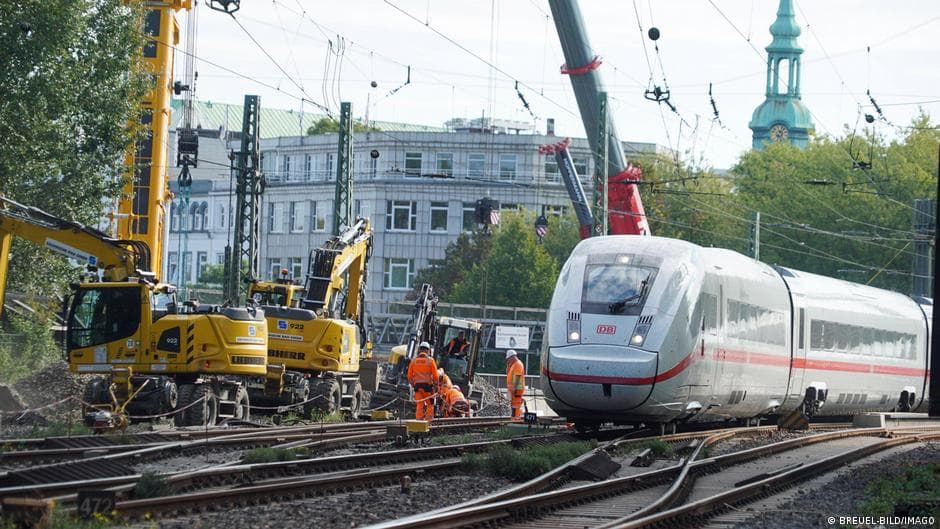
Behold the spectacular collapse of the Teutonic myth. For decades, the world has been forced to endure the insufferable smugness of German engineering, that rigid 'Ordnung muss sein' mindset that suggested if a German train was scheduled for 12:04, it would arrive with the precision of a guillotine. But reality, as it turns out, has a delightful way of urinating on the parade of national stereotypes. The German government, a bickering 'Traffic Light' coalition currently exhibiting the collective competence of a group of toddlers fighting over a single, broken crayon, has finally admitted what every shivering commuter on a platform in Bielefeld already knew: the money is gone, the trains are broken, and the future is a rusted-out rail car heading nowhere.
The news that Berlin is walking back its promised billions for Deutsche Bahn (DB) is the final, pathetic whimper of a nation that has spent years coasting on a reputation it no longer deserves. For those who haven't had the displeasure of navigating the German rail network lately, let me paint a picture of this 'developed' utopia. DB is currently a rolling monument to entropy. Its infrastructure is decrepit, its punctuality is a punchline, and its management appears to be staffed by people who view a timetable as a work of abstract fiction rather than a commitment. In 2023, barely sixty percent of long-distance trains arrived on time, and keep in mind that the German definition of 'on time' includes a six-minute buffer—a grace period that would be considered an eternity in Tokyo, but here serves as a desperate statistical massage for a dying system.
The government’s decision to slash funding projects for national rail is a masterclass in political cowardice. The Greens, those performative guardians of the planet, talk a big game about a 'mobility transition' and getting people out of cars. Yet, here they sit, part of a coalition that is effectively strangling the only viable alternative to the Autobahn. Meanwhile, the Free Democrats (FDP), the self-appointed high priests of the 'debt brake,' worship at the altar of fiscal austerity while the very veins of the nation’s economy—its transit lines—harden into useless calcification. It is the ultimate expression of the modern political condition: a refusal to invest in anything that might actually benefit the public if it risks a decimal point on a spreadsheet. They would rather the country rot in a balanced fashion than thrive on credit.
Let’s be clear about the motives here. This isn't about 'tough choices' or 'budgetary reality.' It’s about a complete vacuum of leadership. The SPD-led government of Olaf Scholz—a man who possesses the charisma of a damp sponge—is terrified of its own shadow. They made grand promises to modernize DB because it looked good on a pamphlet. But now that the bill has come due, they’ve realized that fixing a century of neglect is hard work. It’s much easier to just let the tracks continue to crack and the signals to fail. It’s a slow-motion catastrophe that perfectly mirrors the broader decline of the European project—grand visions of a high-tech, green future being cannibalized by the petty, short-term greed of the present.
What we are witnessing is the death of the social contract in real-time. A government that cannot provide basic infrastructure is a government that has forfeited its right to be taken seriously. They expect the German worker to be productive, to pay their taxes, and to 'save the climate,' all while making it physically impossible for that worker to get to their job without a three-hour delay spent staring at a broken vending machine in a station that smells like despair. The irony is thicker than a Bavarian pretzel: as the world looks to Germany for leadership in the 'Green Revolution,' Germany is literally dismantling the tracks to get there.
In the end, this is what humanity deserves. We are a species that builds cathedrals of bureaucracy to manage our own decline. We talk about high-speed rail and interconnected continents while we can't even keep a commuter train from catching fire in a suburb of Frankfurt. The German government’s retreat on rail funding isn't just a budget cut; it’s an admission of failure. It’s an acknowledgment that the myth of German efficiency was just that—a myth, marketed to the world by people who are now too tired, too broke, and too stupid to keep the lights on. So, the next time you’re standing on a platform in Berlin, waiting for a train that was cancelled twenty minutes ago, remember: this is exactly what they planned for you. Silence, stagnation, and the slow, grinding sound of a nation going nowhere fast.
This story is an interpreted work of social commentary based on real events. Source: DW